

Series: What Actually Mattered at LegalWeek 2026 — Part 3 of 6
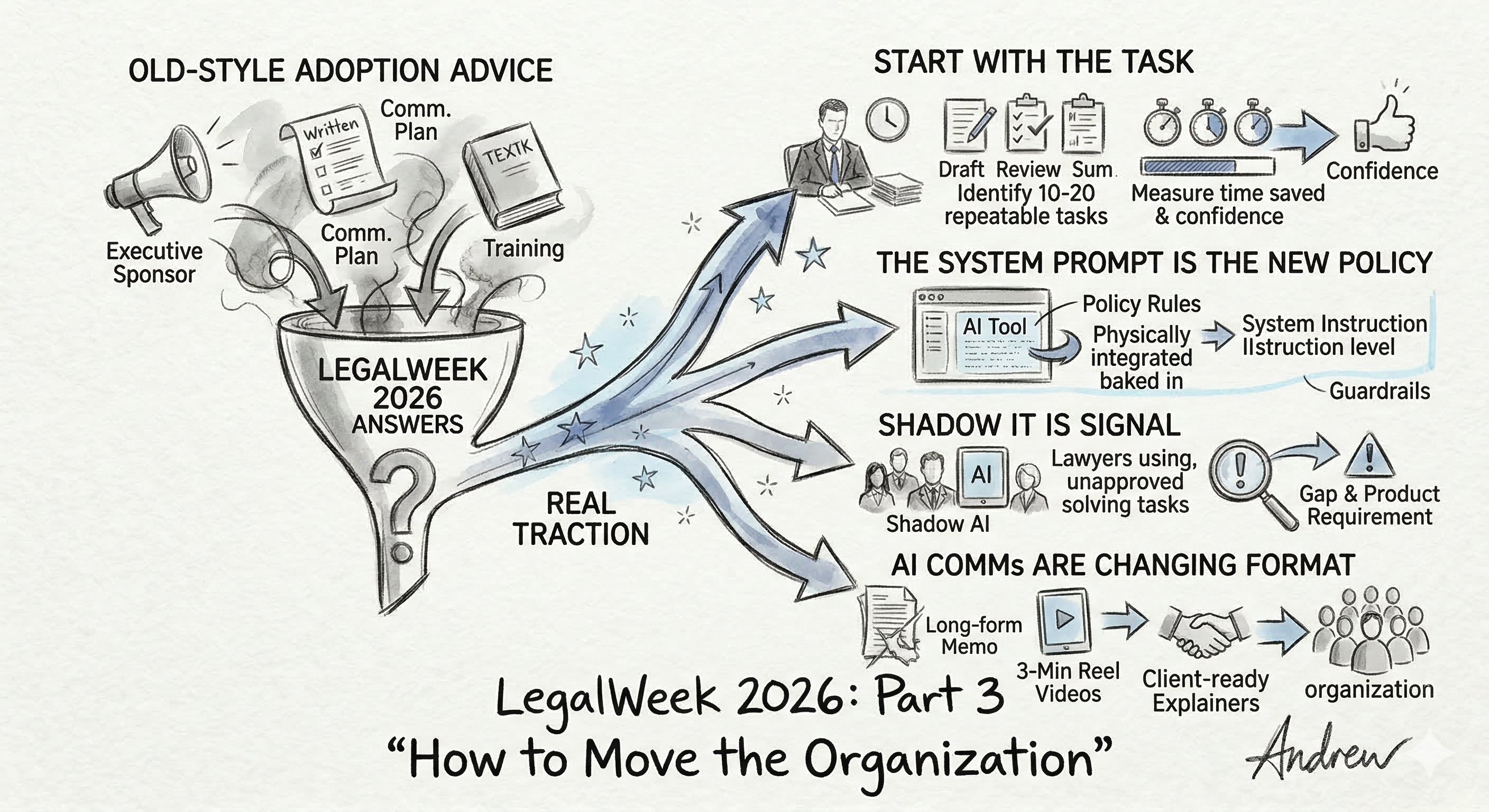
There’s a particular flavour of adoption advice that shows up at every legal technology conference. It sounds like: “You need executive sponsorship, a clear communications plan, and training resources.” It’s not wrong. It’s just not useful. Everyone already knows that. The question is how — and LegalWeek this year actually had some answers worth paying attention to.
Start With the Task, Not the Tool
The most consistently cited training model across sessions was what I’d call task-first AI training. The structure is straightforward, even if the execution is hard:
Identify the ten to twenty most repeatable legal tasks in your practice groups. These aren’t the edge cases. They’re the drafting, review, summarisation, and research patterns that eat up the majority of associate and junior partner time. Then build your training around those tasks — not around the AI tool’s feature set.
The practical version looks like this: you drop a lawyer into a simulated matter. Time pressure, incomplete facts, realistic constraints. The AI tool is available, but so is everything else. The goal isn’t to teach the tool. The goal is to measure whether the lawyer can produce better work, faster, when AI is part of their workflow.
Firms doing this are tracking two things: time saved and confidence gained. The second one matters more than people think. A lawyer who finishes a task 30% faster but doesn’t trust the output will stop using the tool within a month. Confidence is the leading indicator that sticks.The System Prompt Is the New Policy Document
Here’s something that wouldn’t have made sense two years ago: firms are embedding their AI policies directly into system prompts.
They’re formalising AI policies, defining risk tiers, listing approved use cases — and then encoding those rules into the system-level instructions that shape how AI tools behave for their lawyers. The result is governance that feels invisible when done right. Instead of a PDF that nobody reads, you get guardrails that are baked into the tool itself.
This is a meaningful evolution. It’s the difference between telling people the rules and engineering an environment where the rules are hard to break. I find this approach far more promising than the compliance-training model most firms default to, because it shifts the burden from the individual lawyer to the system design.
Shadow IT Is Signal, Not Threat
This was my favourite insight of the conference, and the one I think has the most untapped potential.
Firms are starting to track which AI sites their lawyers are visiting. Not to police them — to understand what problems those lawyers are trying to solve that the firm hasn’t enabled yet.
Think about what that data tells you. When a corporate associate is spending time on ChatGPT drafting contract summaries, that’s not a compliance failure. That’s a product requirement. It’s telling you exactly where the gap is between what the firm provides and what practitioners actually need.
The question to ask isn’t “how do we stop this?” It’s “what are people trying to do that we haven’t enabled?”
I’ve started looking at shadow AI usage in my own context through this lens, and it’s clarifying. The patterns don’t lie. When you see clusters of unsanctioned tool use around a particular task or practice area, you’ve found your next pilot programme.AI Communications Are Changing Format
One more tactical note that’s worth flagging: the way firms communicate about AI internally is shifting away from long-form memos and town halls toward short, consumable formats.
The firms getting traction are producing three-minute, reel-style videos and plain-language explainers. That tracks with everything we know about how busy professionals actually absorb information. The forty-five-minute webinar has its place, but it’s not how you move a two-thousand-person organisation.
There’s also a shift in what the communications are about. The focus is moving from internal capability (“here’s what our AI tool can do”) toward client readiness (“how many AI questions are clients asking, and are our lawyers prepared to answer them?”). That reframing matters. It connects AI adoption to revenue and client relationships, which is the language that moves partners.
Next in this series: How usage transparency, peer pressure, and practice group roundtables are doing more for adoption than any top-down mandate.
Andrew is a Director of AI and Innovation at a large Canadian law firm. He writes about what AI adoption actually looks like from inside the institution.