

Series: What Actually Mattered at LegalWeek 2026 — Part 2 of 6
If you only follow the headline-grabbing AI announcements — the new tools, the vendor partnerships, the “we’re using AI to do X” press releases — you’d miss the most significant operational shift happening inside law firms right now.
Knowledge teams are exploding.
Not in the dramatic, “we hired a Chief AI Officer” way that makes the legal press. In the structural, quiet, “we’ve doubled headcount in our knowledge and innovation function” way that only becomes visible when you compare org charts twelve months apart.
The Role Has Changed
This isn’t just growth for growth’s sake. The role of these teams is fundamentally different from what it was even two years ago.
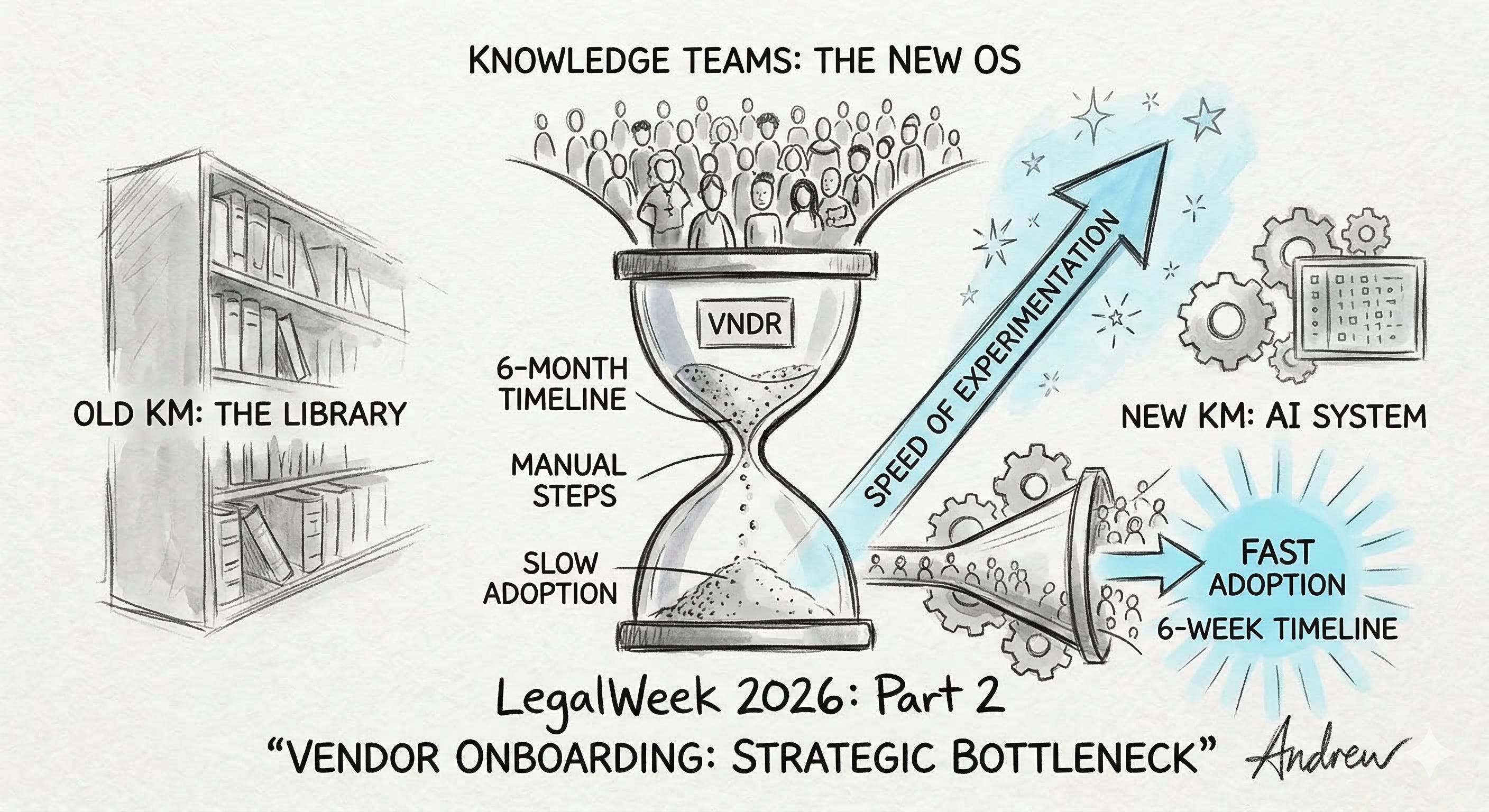
The old knowledge management function was a library. Precedent banks, template repositories, know-how databases. Important work, but bounded. The new function is closer to an operating system for the firm’s relationship with AI. It spans tool evaluation, prompt design, lawyer enablement, and quality control — and increasingly, it’s the function that determines whether any given AI initiative actually lands with practitioners or dies on the vine.
I’ve seen this shift from the inside, and the scale of it catches people off guard. Every new AI tool that enters the firm needs someone to evaluate it, pilot it, build the guardrails around it, design the training, measure the adoption, and troubleshoot when things don’t work as expected. Multiply that across a dozen tools and a few thousand lawyers, and you start to understand why these teams are growing.
The insight that resonated most at LegalWeek: AI doesn’t eliminate knowledge work. It raises the bar on it. The firms that understand this are investing accordingly. The ones that don’t are burning out small teams and wondering why adoption numbers stay flat.Vendor Onboarding Is Now a Strategic Bottleneck
Here’s a related shift that doesn’t get enough attention: the path from “we’d like to try this tool” to “it’s live in production” has become a full pipeline — and at most firms, that pipeline is slow.
The common stages are familiar to anyone who’s lived through enterprise procurement: legal review, information security assessment, procurement negotiation. None of these steps are unreasonable. All of them take time. And the cumulative effect is that firms without a fast, standardised intake process are falling behind — not because they’re taking on more risk than their competitors, but because they’re taking longer to make decisions.
This is one of those operational details that doesn’t make it into conference keynotes, but it determines outcomes more than most strategic decisions do. A firm that can evaluate, approve, and deploy a new AI tool in six weeks has a compounding advantage over one that takes six months. Not because the tool itself is transformative, but because the speed of experimentation becomes a capability in its own right.
I’ve been pushing on this in my own context — trying to turn what was an ad hoc, relationship-driven intake process into something repeatable and predictable. It’s not glamorous work. But every week you shave off the onboarding cycle is a week your lawyers get to start learning what works and what doesn’t.What This Actually Means
The structural message from LegalWeek was clear, even if nobody put it on a slide: the firms that are serious about AI are building internal infrastructure that looks nothing like a traditional law firm support function. They’re building product teams, design capabilities, enablement programmes, and operational pipelines.
This costs real money. It requires real headcount. And it demands that firm leadership treat AI adoption as an ongoing operational commitment, not a one-time capital expenditure.
That’s the part most firms haven’t fully internalised yet.
Next in this series: The specific training, communications, and adoption tactics that are actually working — from task-first training models to the surprising value of tracking shadow IT.
Andrew is a Director of AI and Innovation at a large Canadian law firm. He writes about what AI adoption actually looks like from inside the institution.