

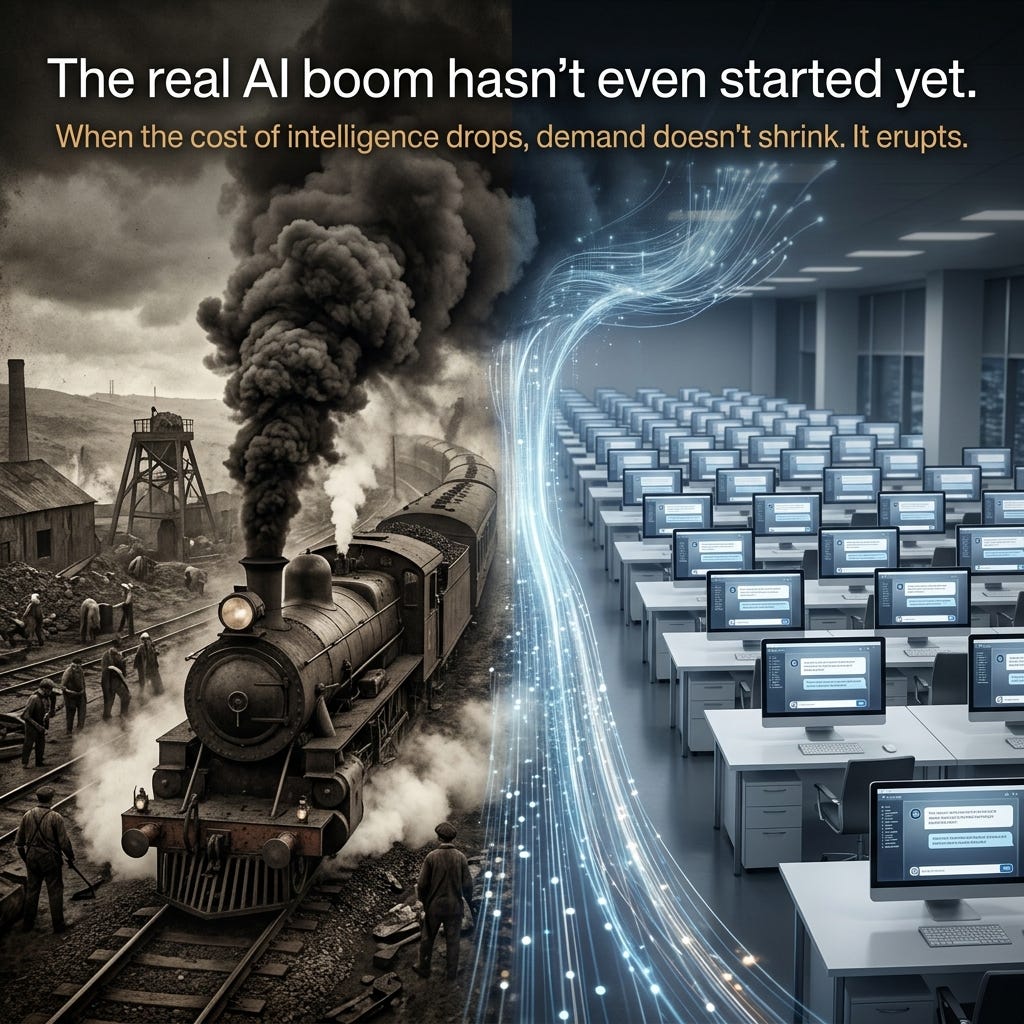
In 1865, England figured out how to burn coal more efficiently. The natural assumption was that the country would use less coal. Instead, it used more. Way more.
That one fact explains why the dominant narrative about AI and jobs has a fatal flaw built into its foundation.
Right now, there’s a panic spreading through every office, every Slack channel, every LinkedIn feed. The fear is straightforward: AI makes knowledge work so efficient that companies won’t need as many people. Fewer engineers. Fewer analysts. Fewer lawyers.
But what if making work faster doesn’t shrink the workforce — it explodes it?
There’s a 160-year-old economic rule that predicts exactly what’s coming. And once you see it, you can’t unsee it.
The Paradox
Here’s the story. It’s 1865. A British economist named William Stanley Jevons notices something that makes no sense.
Steam engines have gotten dramatically more efficient. Everyone assumes England will use less coal. The math seems obvious — better engines, less fuel.
But the opposite happens. Because the engines are so efficient, it suddenly becomes cheap to use steam power for everything. Factories that couldn’t afford steam engines before? Now they can. Industries that never used steam? Now they do. Total coal consumption doesn’t drop. It skyrockets.
That’s the Jevons Paradox: increased efficiency doesn’t reduce demand. It creates it.
This isn’t just a cute story about coal. We’ve already seen this exact pattern play out in your lifetime.
The Spreadsheet Proof
The 1980s. Electronic spreadsheets hit the market — VisiCalc, Lotus 1-2-3, eventually Excel. A single accountant could suddenly do in an hour what used to take a room full of clerks an entire week.
The panic was immediate. Computers are going to eat accounting.
But here’s what actually happened. Because complex math was suddenly so cheap and fast, companies didn’t fire their finance teams. They asked for more math. They wanted daily forecasts. Risk modeling. Scenario analysis. Deep analytics on every product line.
The number of financial analysts and accountants didn’t shrink. It multiplied.
The spreadsheet didn’t kill finance. It made math so cheap that companies wanted ten times more of it. The Jevons Paradox, playing out right in front of us.
The Cognitive Boom
Now let’s talk about right now.
Today, cognitive labor — coding, writing contracts, doing market research, designing campaigns — is expensive and slow. So companies only do what is strictly necessary. You only build software for mass markets. You only have lawyers review the most critical contracts. You only run marketing campaigns for your biggest audiences.
But what happens when AI makes a programmer ten times more efficient? The company doesn’t fire ninety percent of its engineers and build the same app. The cost of creating software plummets. And when the cost drops, the demand doesn’t stay flat.
It erupts.
Think about a law firm. Fifty lawyers. Today, they can only take on high-value cases because legal work is so labor-intensive. But with AI handling contract review, research, and first drafts? Suddenly, thousands of cases that were previously too small or too expensive to touch become viable. That firm doesn’t lay off forty lawyers. It hires two hundred more to manage the flood of newly accessible work.
The same pattern hits every field:
Marketing campaigns become viable for niche audiences that were previously too small to justify the spend.
Custom software becomes economical for markets that couldn’t afford it before.
Legal services become accessible to small businesses for the first time.
And in every single case, you still need humans to direct the AI, manage the projects, make the judgment calls, and ensure quality.
When the cost of intelligence drops, we don’t consume the same amount of intelligence with fewer people. We consume radically more intelligence. We start tackling projects that were too expensive or too complex to even attempt.
We don’t shrink the economy. We scale it up.
Your Move
This is not the automation of existing work. This is the creation of entirely new categories of work that were previously too expensive to exist.
So here’s the exercise worth doing: look at your current role. What work does your company skip because it’s too expensive or too slow? That skipped work is your expansion zone. That’s where the new jobs, the new teams, the new opportunities are going to come from.
Don’t position yourself as the person AI replaces. Position yourself as the person who directs AI into that latent demand.
The professionals who thrive in this next decade won’t be the ones who fear the efficiency. They’ll be the ones who see the rebound.
AI isn’t the end of white-collar work. It’s the beginning of the cognitive boom.
What work does your company currently skip because it’s too expensive? That’s your Jevons Paradox moment waiting to happen. I’d love to hear it in the comments.