

Series: What Actually Mattered at LegalWeek 2026 — Part 6 of 6
I’ve spent the previous five articles in this series describing what I saw and heard at LegalWeek — the themes, the operating model shifts, the tactics that are working, and the hard conversations that aren’t happening yet.
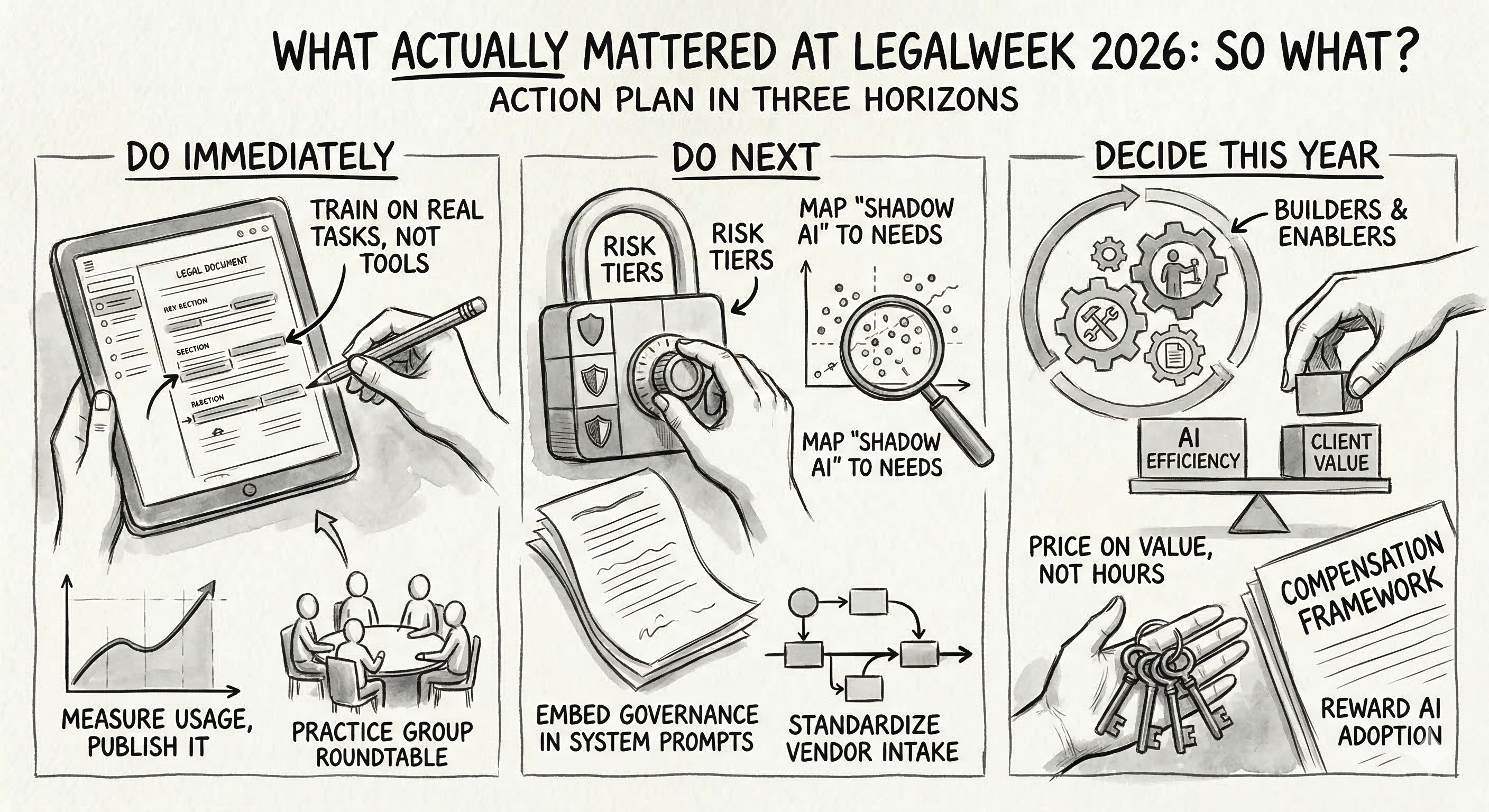
This final piece is different. It’s the “so what” — the part where observation turns into action. I’ve organised it into three horizons based on urgency, complexity, and how much organisational consensus each move requires.
Do Immediately
These are moves that require minimal approval, no structural change, and can start generating signal within weeks.
Shift AI training to task-based, simulated matters. If your training programme still starts with “here are the features of this tool,” stop. Identify the ten to twenty most repeatable legal tasks in your practice groups and build training around those. Use realistic simulated matters with time pressure and incomplete facts. Measure both time saved and — critically — confidence gained. The confidence metric is what tells you whether adoption will stick.
Publish usage metrics by practice group. Take whatever AI tool usage data you have — Harvey, CoCounsel, whatever — and make it visible across the firm, broken down by practice group. Don’t attach mandates to it. Don’t set targets. Just publish the numbers and let the peer dynamics do the work. This is the lowest-cost, highest-signal adoption tactic I encountered at the entire conference.
Stand up a practice group AI roundtable. One representative from each practice group. Each brings one real use case. No slides, no vendor demos, no keynotes. The constraint is what makes it work: “one real use case” forces specificity, keeps sessions short, and creates the social proof that training programmes can’t replicate.Do Next
These require more coordination and some cross-functional buy-in, but they’re achievable within a quarter.
Formalise AI risk tiers and embed them in system prompts. If your AI policy is a standalone document that lives on an intranet page, it’s time to encode it. Define risk tiers for different use cases. Map approved tools to those tiers. Then embed the guardrails directly into the system-level prompts that shape how AI tools behave for your lawyers. Governance that’s invisible when done right is governance that actually works.
Map shadow AI usage to unmet needs. Talk to your IT or security team about which AI sites lawyers are visiting outside the firm’s approved tools. Don’t approach this as a compliance exercise. Approach it as market research. The patterns will tell you exactly where the gap is between what you provide and what practitioners actually need. That’s your next pilot programme.
Standardise vendor intake to reduce cycle time. Audit how long it takes a new AI tool to move from initial interest to production deployment. If the answer is measured in months, figure out where the bottleneck is — legal review, InfoSec, procurement — and build a repeatable, transparent process with target timelines for each stage. Speed of experimentation is a compounding advantage.Decide This Year
These are strategic decisions that require partnership-level conversation and real organisational commitment. They can’t be delegated to a working group or deferred to next year’s strategy cycle.
Where specialist AI talent fits. If your AI adoption effort is staffed entirely by repurposed knowledge management professionals and a single innovation lead, you need to have an honest conversation about what’s missing. Builders — people with technical depth who can also navigate firm politics — are a different kind of hire. Decide where they sit, who they report to, and what success looks like for them. Enablement without builders stalls.
How pricing reflects AI leverage. If AI is cutting the time on certain tasks by 60% or more, your pricing model is drifting out of alignment with the value you deliver and the efficiency you’ve gained. You may not need to overhaul your pricing framework this year, but you need to start the conversation — because clients are going to start it for you if you don’t.
Whether compensation rewards AI leadership — or punishes it. This is the decision that reveals whether everything else is real. If your compensation framework doesn’t recognise AI adoption, innovation leadership, or efficiency gains, then those things aren’t strategic priorities. They’re aspirations. Your compensation plan is your strategic plan. If AI doesn’t show up there, it isn’t real.
The Series in Review
Over these six articles, I’ve tried to describe what LegalWeek 2026 revealed about where law firm AI adoption actually is — not where the marketing says it is, but where the honest conversations are happening.
The tools are everywhere. Differentiation is gone. The constraint is now organisational: habits, trust, incentives, process, talent, and pricing. The firms that treat AI as a technology problem will keep stalling. The ones that treat it as an operating model problem will keep moving.
None of this is easy. But the path is clearer than it was a year ago, and the firms that take it seriously have a window to build a real advantage before the rest of the market catches up.
Andrew is a Director of AI and Innovation at a large Canadian law firm. He writes about what AI adoption actually looks like from inside the institution.