

Series: What Actually Mattered at LegalWeek 2026 — Part 5 of 6
LegalWeek had plenty of optimism. Plenty of impressive demos. Plenty of panels about what’s working.
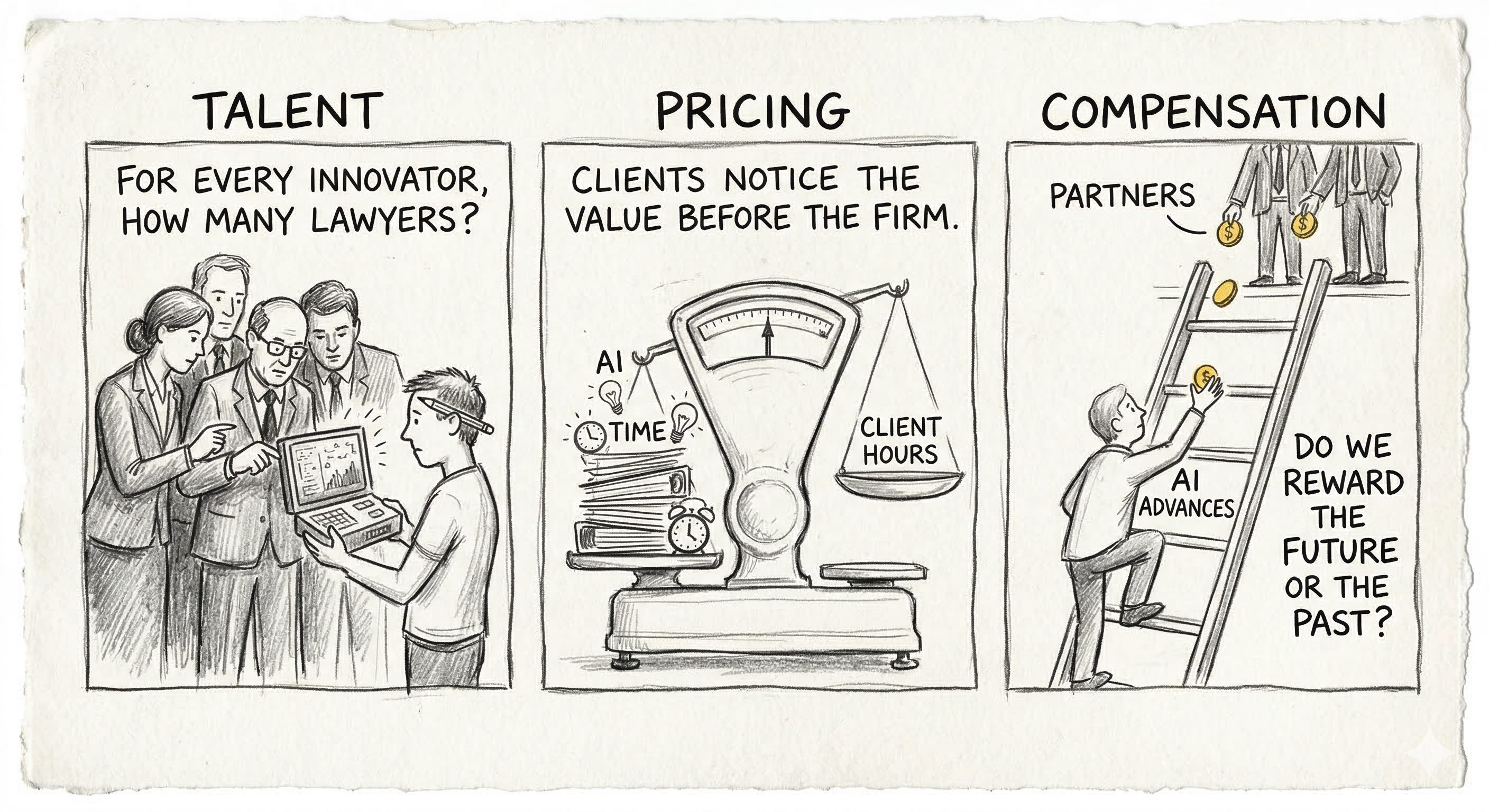
But the most useful conversations were the ones about what’s not working — and more specifically, about the structural problems that firms acknowledge privately and avoid publicly. Three stood out.
The Talent Gap Nobody Wants to Name
Most firms are now training lawyers on AI. That’s genuine progress. Two years ago, most weren’t.
But training lawyers to use AI tools is not the same thing as building the capability to push AI forward. Firms are investing in enablement — training, change management, communications — while underinvesting in the specialist talent needed to design, build, and evolve AI-powered workflows.
The pattern looks like this: you hire a Director of Innovation, or you expand the knowledge team, and you expect that small group to handle everything from tool evaluation to prompt engineering to strategic planning. It works for a while. Then it doesn’t, because enablement without builders stalls. You can train a thousand lawyers to use a tool, but somebody has to decide which tool to deploy, how to configure it, how to integrate it into existing systems, and how to iterate when the first version doesn’t work.
That “somebody” is a different kind of hire than most firms are comfortable making — someone with technical depth who can also navigate the political and cultural realities of a partnership. The talent market for those people is thin, and firms that wait too long to hire them will find that the gap between their ambitions and their capabilities keeps widening.
I feel this tension in my own work. The scope of what needs doing grows faster than the team. And the solution isn’t to work harder — it’s to build a team with the right mix of skills, which requires a hiring conversation that most firms haven’t had yet.Pricing Is Misaligned and Clients Will Notice First
Here’s the second hard conversation: AI is improving speed and leverage. In many cases, work that used to take forty hours now takes ten. That’s great for efficiency. It’s terrible for a business model built on billing hours.
The pricing models at most firms haven’t caught up. And here’s the uncomfortable part — clients are going to notice before firms do. A client who knows that AI-assisted contract review takes a fraction of the time it used to is going to ask why the invoice looks the same.
This isn’t a future problem. It’s a present one. The firms that address it proactively — by experimenting with fixed-fee arrangements, value-based pricing, or at minimum transparent disclosure of AI-assisted work — will build client trust. The ones that don’t will face the conversation on the client’s terms, which is always worse.
I don’t have a clean answer here. Nobody at LegalWeek did either. But the acknowledgment that this conversation is overdue was widespread, and the firms thinking about it seriously tend to be the same ones that are ahead on adoption more broadly.Compensation Is the Reveal
The third conversation is the one that separates firms that are serious about AI from firms that are performing seriousness.
Almost no firms — very few, maybe a handful — are aligning compensation with AI adoption, innovation leadership, or efficiency gains. Everyone agrees they should. Almost nobody has done it.
This matters more than it might seem, because compensation is the only signal that the partnership structure actually respects. You can issue all the strategy memos you want. You can create innovation committees and AI task forces and digital transformation programmes. But if the compensation framework doesn’t reward the behaviour you say you value, then the behaviour won’t change.
Your compensation plan is your strategic plan. That’s not a slogan. It’s a diagnostic. If AI adoption, innovation leadership, and efficiency gains don’t show up in how people are paid, then those things aren’t strategic priorities — they’re talking points.
The firm that figures this out first — that creates a credible, measurable link between AI-driven performance and partner compensation — will have an enormous talent and adoption advantage. Everyone else will keep having the same conversation at next year’s conference.
The Common Thread
All three of these problems — the talent gap, the pricing misalignment, and the compensation question — share a root cause. They require firms to change something structural about how they operate, not just add something new on top.
Adding a tool is easy. Rewriting a compensation framework is hard. Building a vendor intake pipeline is manageable. Rethinking pricing is existential. Hiring an enablement team is safe. Hiring builders is unfamiliar.
The firms that move on these hard conversations won’t do it because it’s comfortable. They’ll do it because the alternative — stalling out at the enablement stage while competitors build real capability — is worse.
Next in this series: A practical takeaway framework — what to do immediately, what to do next, and what to decide this year.
Andrew is a Director of AI and Innovation at a large Canadian law firm. He writes about what AI adoption actually looks like from inside the institution.