

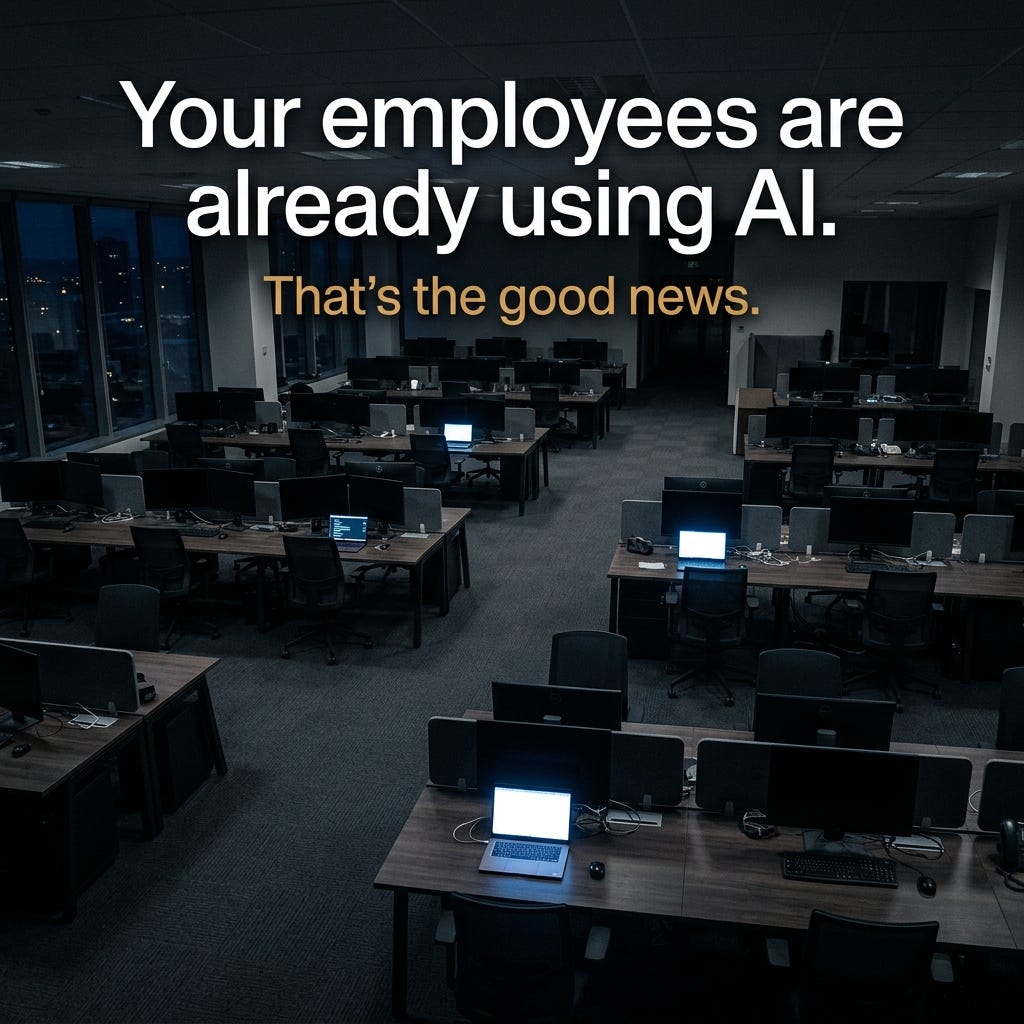
There’s a term making the rounds in enterprise circles right now: shadow AI.
If you work in security or IT governance, you probably hear it as a threat. Employees using ChatGPT on personal accounts. Pasting client data into tools nobody approved. Building little automations that nobody knows about until something breaks.
And yes — that’s real. The data on it is pretty stark. Microsoft’s 2024 Work Trend Index found that 75% of knowledge workers now use AI at work, and 78% of them are bringing their own tools — what Microsoft calls “BYOAI.” A BlackFog survey found roughly half of workers admit to using AI tools without employer approval. A KPMG study puts it even higher — 57% say they’ve submitted AI-generated work as their own without telling their manager.
But the part most of the coverage misses is that people don’t hide their AI use out of malice. They hide it because nobody told them it was okay. No guidance, no approved tools, no one saying “yes, use this — here’s how to do it without creating a mess.”
The View From Inside
I run AI enablement and delivery at a large Canadian law firm. When I say “run,” I mean I’m the person in the room when we decide what tools to approve, how to govern their use, and what happens when someone finds a shortcut we didn’t anticipate.
And I can tell you: shadow AI doesn’t start with rebellion. It starts with silence.
An associate finds that Claude drafts better first-pass research memos than starting from a blank screen. A paralegal discovers that summarizing long contracts is faster with a chat interface than with manual notes. A business services team member figures out that AI can write a decent first draft of an internal communication in a quarter of the time.
None of these people are trying to break rules. They’re trying to do their jobs. The organization just hasn’t caught up to the speed at which these tools became useful.
Most of the articles about shadow AI treat it like a leak to plug. Install monitoring software. Ban unsanctioned tools. Train people on the risks.
That framing has it backwards.
Shadow AI is what happens when your governance moves at committee speed and your employees move at tool speed. The gap between those two speeds is where unofficial use grows — not because people are reckless, but because the formal path either doesn’t exist or takes six months.
The Demand Signal
After watching this unfold inside a conservative institution, one thing keeps standing out:
The people using AI in secret are your early adopters. They already see the value. They’ve figured out where it fits. They’re exactly who you want on your side when it’s time to roll something out for real.
When you discover shadow AI, you have two options.
The first option is containment. Lock down access, monitor usage, send a compliance memo. This is the default in regulated industries, and it’s understandable. The risks are real — confidentiality, privilege, data residency. In legal, putting client information into an unapproved tool isn’t just a governance violation. It’s potentially a professional conduct issue. In February 2026, Judge Rakoff in United States v. Heppner ruled that documents a defendant created using a consumer version of Claude were neither privileged nor work product — privilege was gone the moment he hit enter on a public AI tool. That’s the kind of consequence that makes CISOs lose sleep.
And this isn’t hypothetical exposure. Clio’s 2025 Legal Trends Report found that 79% of legal professionals now use AI, but more than half say their firm has no AI policy or they’re unaware of one. That gap between usage and governance is where the risk concentrates.
The second option is acceleration. Take the signal seriously. Ask: what are people actually using AI for? Where is the demand highest? What would it take to offer an approved path that’s fast enough that people actually use it instead of going around it?
In my experience, the second option works better. Not because the risks don’t matter — they absolutely do — but because containment without an alternative just pushes usage further underground. People don’t stop using the tool. They get better at hiding it.
What the Enablement Response Actually Looks Like
When we discover unofficial AI use, the first conversation isn’t “you shouldn’t have done that.” It’s “tell me about your workflow.”
That conversation usually tells you more than any audit would.
The use case is almost always reasonable. People aren’t using AI to cut corners on judgment calls. They’re using it to speed up the mechanical parts — drafting, summarizing, organizing, reformatting. Work that takes time but doesn’t require expertise.
The risk is usually more contained than you’d expect. Someone using AI to draft an internal email isn’t creating the same exposure as someone pasting client financials into a public model. Understanding the actual risk surface matters more than treating all AI use as equally dangerous.
And the gap between what people want and what the organization provides is almost always about governance, not technology. We have access to enterprise AI tools. The problem is that the approval process, the usage policies, and the training haven’t kept pace with how fast people figured out the tools are useful.
Once you understand those three things, the path forward is pretty clear: fast-track the governance for the use cases people are already doing. Don’t build the perfect policy. Build the minimum viable policy that lets people work safely, and iterate from there.
The Uncomfortable Part
There’s something else going on that the shadow AI conversation mostly avoids: the reason employees hide their AI use isn’t always about missing policies.
Sometimes it’s about culture.
Some people hide AI use because they think their manager will see it as cheating. Some worry they’ll look less skilled — that if the work is partially AI-generated, it somehow doesn’t count. Others are afraid that admitting they use AI to work faster just means they’ll be assigned more work at the same pay.
That’s a leadership problem, not a technology one.
If your culture treats AI use as a confession rather than a competency, you’ll get secrecy. If your managers don’t know how to evaluate AI-assisted work, they’ll default to suspicion. And if your organization’s implicit message is “we’ll adopt AI eventually, but not yet,” your employees will hear “figure it out yourself and don’t tell anyone.”
The organizations that handle this well share a common trait: they treat AI use as a skill to develop, not a shortcut to police.
So What Do You Do With This?
Shadow AI isn’t a crisis to manage. It’s evidence that the transformation you’ve been planning is already happening — just without your involvement.
The question isn’t how to stop people from using AI. That ship sailed. The question is whether you can make the official path better than the workaround.
Because right now, in most organizations, the workaround is faster, easier, and more accessible than whatever the IT governance committee approved nine months ago.
If you’re responsible for AI adoption in any capacity, the existence of shadow AI should feel encouraging. The demand is real. The use cases are already proven. You don’t need to manufacture an adoption curve.
You just need to catch up to your own people.
What does shadow AI look like in your organization — and is the response containment, acceleration, or something in between?