

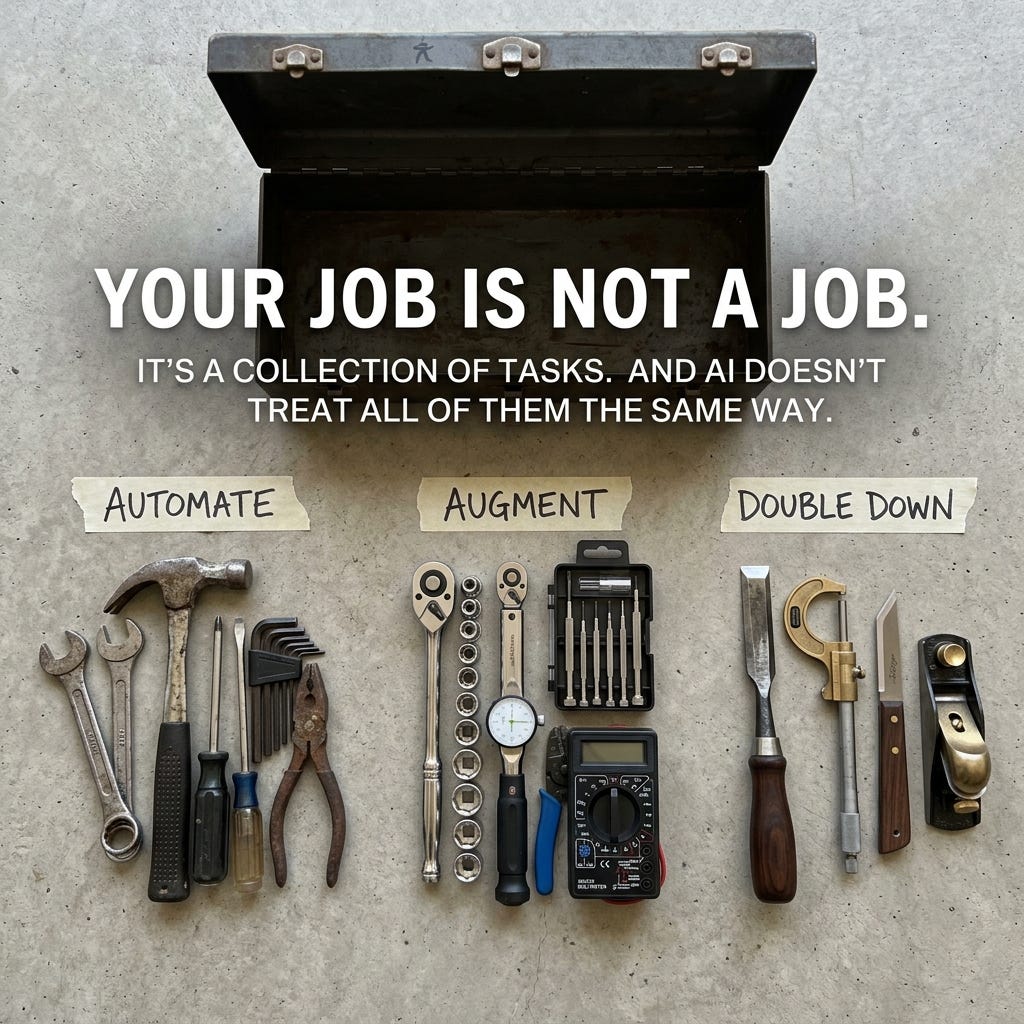
Everyone’s asking the wrong question right now. “Will AI take my job?” “Will AI replace engineers?” “Is marketing dead?”
That question is broken — because AI doesn’t see your job the way you do. You see a job title. AI sees a stack of individual tasks. It’s coming for some of them, it’s going to supercharge others, and there are some it can’t touch at all.
Today I’m going to walk you through a framework to figure out which is which — and give you a prompt you can run right now to get your personal AI career strategy in five minutes.
Jobs are task collections
Think about your actual workweek. Not your title — what you actually do, hour by hour.
If you’re a software engineer, some of your time goes to writing boilerplate code. Some goes to architecture decisions. Some goes to code reviews. Some goes to negotiating requirements with stakeholders.
Those are all different tasks. And they have wildly different relationships with AI.
It’s like looking at a toolbox. You wouldn’t throw out the whole thing just because one wrench is worn out. You’d swap the worn tools and keep the ones that still work.
The wrong question: “Will AI replace software engineers?”
The right question: “Which tasks inside software engineering are automatable — and which ones become more valuable?”
A job title is just a container. AI doesn’t replace containers. It transforms what’s inside them.
The framework: Automate, Augment, Double Down
Every task in your job falls into one of three categories.
1. Automate
These are tasks you hand off to AI entirely. It’s faster than you, the output is good enough, and your time is better spent somewhere else.
2. Augment
AI is your co-pilot here. You’re still driving, you’re still making the calls — but you’re moving two to five times faster than before.
3. Double Down
These are your moat. Pure human value. The tasks where no AI can replace what you bring to the table.
Automation frees your time. Augmentation multiplies your output. Doubling down is how you become irreplaceable.
How to categorize your tasks
A task is automatable when it’s repetitive, pattern-based, and low-stakes. Status reports. Data entry. Boilerplate drafting. Here’s the gut check: if it bores you and a minor mistake wouldn’t cause a fire, hand it off.
A task is augmentable when it requires your judgment, but the legwork leading up to that judgment is slow. Think legal analysis, market research, drafting proposals. AI gets you to 80% in 10% of the time. You bring the last 20% — the context, the taste, the strategic direction. It’s like having a research assistant who never sleeps but still needs you to make the final call.
A task is a “double down” when it involves high-stakes judgment, deep relationships, or institutional context that no model has. The client dinner. The negotiation. The decision that requires knowing the politics and the people. These are the tasks people pay a premium for — and here’s the key — they become more valuable as everything else gets cheaper.
The goal is not to protect every task you do today. It’s to ruthlessly focus on the ones where you deliver irreplaceable value. Let the rest go.
The AI Task Audit
Here’s the process.
Step 1 — List every task that eats up your work week. Aim for at least ten. Be specific. Not “engineering” — break it down. “Writing unit tests.” “Reviewing pull requests.” “Attending sprint planning.”
Step 2 — Rate each task on AI automation potential. 1 means it absolutely requires a human. 10 means AI can do it today, no supervision needed.
Step 3 — Rate each task on a human edge score. 1 means it’s generic and commoditized — anyone could do it. 10 means it requires your irreplaceable judgment or relationships.
Step 4 — Categorize. Automate, augment, or double down.
You can absolutely do this manually with a spreadsheet. But I’ve also built a prompt that does the whole analysis for you.
The prompt
Paste the following into Claude, ChatGPT, or whichever AI assistant you prefer. Replace the bracketed sections with your details.
You are a career strategist specializing in AI workforce transformation.

I'm going to give you my role, industry, and a list of tasks that make up my
typical work week. For each task, I want you to:

1. Rate it on AI Automation Potential (1–10, where 1 = absolutely requires a
   human and 10 = AI can do this today with no supervision)
2. Rate it on Human Edge Score (1–10, where 1 = generic/commoditized and
   10 = requires irreplaceable judgment, relationships, or context)
3. Categorize it as: AUTOMATE, AUGMENT, or DOUBLE DOWN

Then sort the table by automation potential (highest first) and give me a
three-sentence career strategy brief telling me where to focus my energy.

My role: [Your role]
My industry: [Your industry]
My tasks:
1. [Task 1]
2. [Task 2]
3. [Task 3]
...
Here’s what catches people off guard: the output is often surprising. Tasks you thought were safe show up as highly automatable. And tasks you’ve been rushing through — the ones you thought were low-value — turn out to be your highest-value work. That’s the whole point. It forces you to see your job the way AI sees it. Not through your title, but through your tasks.
The shortcut
If your AI assistant is already connected to your email and calendar — Copilot, Claude, whatever you’re using — it already knows what your tasks are.
Just ask it: “Based on my last two weeks of meetings and emails, what tasks consumed most of my time?”
Then run the audit on that list. The data is already sitting there. You just need to ask the right question.
Your homework
Your career strategy is not about learning to use AI tools. Everyone’s going to learn the tools — that’s table stakes. Your strategy is knowing which of your tasks to hand to AI, and which ones to never let go.
Here’s what I want you to do this week:
Run the task audit. List your tasks, rate them, categorize them.
Identify your top three “double down” tasks. That’s your career moat.
Find two tasks you can automate immediately and reclaim that time.
Redirect those freed-up hours into your highest-value work. That’s where you win.
Your job is not a job. It’s a collection of tasks. And the ones worth keeping are the ones only you can do.
Drop your role in the comments — I’m curious what tasks you’d put in the “double down” column.